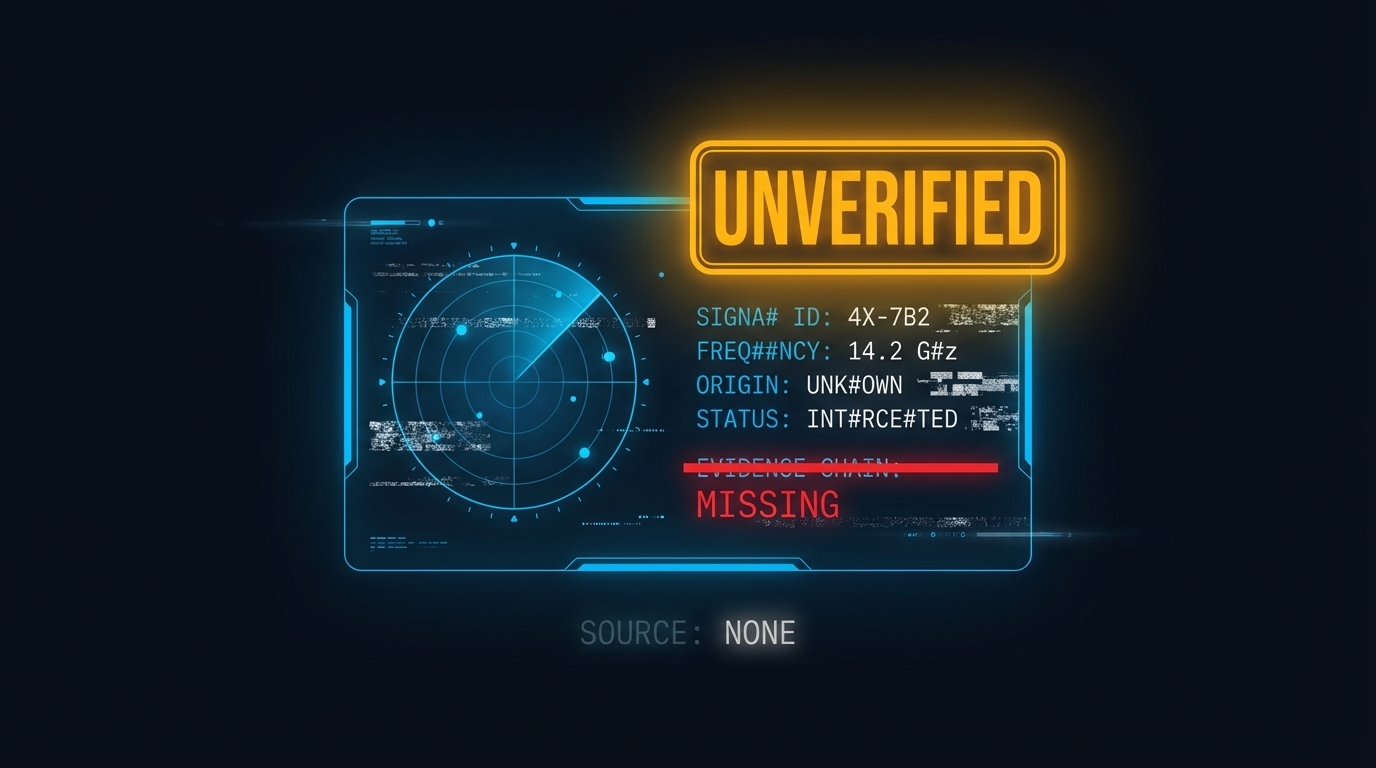
Every PMM team has acted on a competitive intelligence signal that turned out to be wrong. The price change that was not real. The feature launch that was a job posting, classified at high confidence as a product expansion. In 2026, there is a name for this problem: hallucination.
<div style="background:#0E1420; border-left:4px solid #00B4FF; padding:16px 20px; margin:24px 0; font-size:0.95em;">
<strong style="color:#00B4FF; font-size:0.8em; letter-spacing:0.06em; text-transform:uppercase;">Quick Answer</strong><br>
<p style="color:#e2e8f0; margin:8px 0 0; line-height:1.6;">AI hallucination in competitive intelligence occurs when a CI tool produces a confident signal classification or summary with no traceable evidence behind it. The tool asserts a competitor move happened. It cannot show you what changed, what it said before, or where to verify it. Teams act on the signal, update battlecards, and later discover the move was misclassified, stale, or fabricated by the model.</p>
</div>
> Quick Answer: An AI-generated CI signal with no inspectable evidence trail is a hallucinated signal. It may look like competitive intelligence. It produces the same downstream decisions. But it cannot be verified — which means it cannot be trusted.
What AI Hallucination Means in a CI Context
In AI systems broadly, hallucination refers to a model producing a confident output that does not correspond to real data. The model does not flag uncertainty. It does not say "I am not sure." It produces a classified, formatted, high-confidence answer — and that answer is wrong.
Research published in 2025 and 2026 across legal, medical, and financial AI deployments confirms that even leading language models hallucinate at rates significant enough to cause material harm in decision-making contexts. The pattern is consistent: the model sounds credible, the output is wrong, and nobody catches it because the output looks like a real answer.
Competitive intelligence is a high-stakes decision-making context.
When a CI tool misclassifies a page change, a PMM updates a battlecard. Sales uses that battlecard in the next competitive deal. The team positions against a move that happened months ago, never happened, or was a routine copy edit the AI rated as a strategic pivot.
That is not a system error. That is hallucination — applied to competitive intelligence.
Four Ways CI Hallucination Happens
Most commercial CI platforms use AI in their signal generation pipeline. The AI layer handles some combination of content classification, significance scoring, natural language summarization, change detection, and strategic interpretation.
Each of those is a potential hallucination surface.
Classification hallucination occurs when the AI categorizes a page change incorrectly. A competitor updates their pricing page copy for SEO purposes. The model, trained to recognize language about "flexibility," "scale," and "enterprise value," classifies it as a pricing strategy shift. Confidence: 87%. The actual change was a rewritten meta description.
Significance hallucination occurs when the AI assigns strategic weight to a change that does not have it. The model has been trained on strategic communications and press releases. When it encounters language that resembles strategic language, it rates the signal as high-significance. The change was a homepage A/B test variant that was already rolled back.
Temporal hallucination occurs when the tool presents cached or delayed information as current. The system reports a competitor's product page change as "detected yesterday." The actual source was cached data from three weeks ago. The team acts on it as a recent development.
Source hallucination is the most common and the most dangerous. The tool cannot show you the specific text that changed. It cannot show you the before-state. You have a summary, a confidence score, and a classification — but no source URL you can open and verify. If the summary is wrong, you have no mechanism to know.
The Statistics That Raise the Stakes
According to Crayon's 2025 State of Competitive Intelligence report, 60% of CI teams now use AI in their daily workflow, up 76% year-over-year. The same report notes that sellers encounter competitors in 68% of deals.
That means in more than two-thirds of revenue-generating opportunities, teams are relying on CI to inform positioning, pricing conversations, and objection handling.
A majority of those teams are using AI-generated intelligence. The question of whether those outputs are verifiable has become a real business risk.
A March 2026 analysis from Demand Gen Report cited Edelman's Trust Barometer finding that "confidence in business communication remains fragile" and that "buyer interest now starts with proof." The same dynamic applies inside organizations. Confidence scores are not proof. Summaries are not proof. Evidence is proof.
The Three-Question Audit for Your Current CI Tool
Before acting on any competitive intelligence signal, three questions determine whether it is real.
Question 1: Can you see the exact text that changed on the competitor's page?
If the answer is no, the signal has no verifiable foundation. You are being asked to trust a model's interpretation of a change you cannot inspect.
Question 2: Can you see what the page said before the change?
A before-state is the only way to assess the magnitude and nature of a change. Without it, you cannot determine whether the move was strategic or routine.
Question 3: Could you independently verify this signal without the tool's classification?
This is the test most CI tools fail. If the tool went offline tomorrow, could you confirm this signal happened using publicly available information? If not, you are dependent on the model's confidence rather than the evidence.
If your current CI tool cannot pass all three questions for every signal it surfaces, some portion of what your team is acting on is likely hallucinated.
The Cost Nobody Is Tracking
The cost of hallucinated CI is not visible on any dashboard.
PMMs update battlecards based on signals that never reflected real changes. Sales walks into competitive deals with stale positioning. Executives make pricing decisions based on competitor pricing intelligence extracted from an outdated cache. Product roadmaps shift in response to feature launches that were misclassified job postings.
None of this registers as a CI failure. It is absorbed as deal loss, positioning underperformance, and strategy drift. The hallucination leaves no trace.
The only defense is an evidence layer.
What Deterministic Detection Prevents
Metrivant's detection architecture was built specifically to eliminate the hallucination surface in competitive intelligence.
The pipeline is deterministic at every layer that matters: URL scheduling, snapshot capture, diff extraction, and change classification are all rule-based and output-verifiable. AI is used only for interpretation, and only after the evidence has been assembled. The evidence exists independently of the interpretation.
This means every signal in the system includes four verifiable elements: the URL that changed, the before-text extracted from the prior snapshot, the after-text from the current snapshot, and the timestamp of detection.
The classification and strategic implication are AI-generated. They are labeled as AI outputs. The evidence is not.
In March 2026, Metrivant's pipeline detected a coordinated move by Mercury, the B2B fintech company. The system classified it as feature_launch and positioning_shift. The classification was AI-generated. The evidence was not: the exact pages, the before and after text, the confidence score (0.91), and the strategic implication were produced from a verified diff. A PMM could inspect every element of the signal and confirm it independently.
That is what happens when deterministic detection runs before AI interpretation.
For a full comparison of how CI tools handle evidence at the signal level, see how Metrivant's 8-stage pipeline works and what an evidence chain actually contains.
FAQ
What is AI hallucination in competitive intelligence?
AI hallucination in competitive intelligence occurs when a CI tool produces a confident signal summary or classification that does not correspond to a verifiable real-world change. The tool asserts a competitor move occurred but cannot show the before-state, after-state, or source URL to support the claim. Teams act on the signal and later find the change was misclassified, stale, or fabricated by the model.
How do I know if my CI tool is producing hallucinated signals?
Apply the three-question test: Can you see the exact text that changed? Can you see what it said before? Could you independently verify the signal without the tool's classification? If your tool cannot show you the before/after source text for any signal, it does not have a verifiable evidence chain and is structurally vulnerable to hallucination.
Why do CI tools hallucinate if they are trained on real data?
CI tools that use AI for classification and summarization inherit the hallucination risk of the underlying language models. Even when the models are trained on real data, they produce probabilistic outputs that can be wrong with high confidence. The risk is compounded when there is no deterministic evidence layer underneath — when the AI operates directly on web content rather than on extracted, verified diffs.
What is the difference between a verified CI signal and an unverified one?
A verified signal traces back to a specific before/after page diff: the URL that changed, the extracted before-text, the extracted after-text, and a classification the user can test against that evidence. An unverified signal provides a summary and a confidence score with no traceable source. The first is inspectable. The second requires trusting the model.
How does Metrivant prevent CI hallucinations?
Metrivant uses deterministic detection at the snapshot, diff, and extraction layers. AI is applied only for classification and interpretation, after the evidence has been assembled. Every signal includes the source URL, before-text, after-text, classification, confidence score, strategic implication, and recommended action. The AI output is labeled separately from the verified evidence so users always know what was measured and what was inferred.
Start a free trial at Metrivant to see what a verified, inspectable evidence chain looks like on your actual competitors.
<script type="application/ld+json">
{
"@context": "https://schema.org",
"@graph": [
{
"@type": "Article",
"headline": "The AI Hallucination Problem in Competitive Intelligence (2026)",
"description": "AI hallucinations are not just a ChatGPT problem. They occur inside competitive intelligence tools. Here is how to identify the four types of CI hallucination and prevent them with an evidence-first detection architecture.",
"datePublished": "2026-04-02",
"author": {"@type": "Organization", "name": "Metrivant"},
"publisher": {"@type": "Organization", "name": "Metrivant", "url": "https://metrivant.com"}
},
{
"@type": "FAQPage",
"mainEntity": [
{
"@type": "Question",
"name": "What is AI hallucination in competitive intelligence?",
"acceptedAnswer": {"@type": "Answer", "text": "AI hallucination in competitive intelligence occurs when a CI tool produces a confident signal summary or classification that does not correspond to a verifiable real-world change. The tool asserts a competitor move occurred but cannot show the before-state, after-state, or source URL to support the claim. Teams act on the signal and later find the change was misclassified, stale, or fabricated by the model."}
},
{
"@type": "Question",
"name": "How do I know if my CI tool is producing hallucinated signals?",
"acceptedAnswer": {"@type": "Answer", "text": "Apply the three-question test: Can you see the exact text that changed? Can you see what it said before? Could you independently verify the signal without the tool's classification? If your tool cannot show you the before/after source text for any signal, it does not have a verifiable evidence chain and is structurally vulnerable to hallucination."}
},
{
"@type": "Question",
"name": "Why do CI tools hallucinate if they are trained on real data?",
"acceptedAnswer": {"@type": "Answer", "text": "CI tools that use AI for classification and summarization inherit the hallucination risk of the underlying language models. Even when the models are trained on real data, they produce probabilistic outputs that can be wrong with high confidence. The risk is compounded when there is no deterministic evidence layer underneath."}
},
{
"@type": "Question",
"name": "What is the difference between a verified CI signal and an unverified one?",
"acceptedAnswer": {"@type": "Answer", "text": "A verified signal traces back to a specific before/after page diff: the URL that changed, the extracted before-text, the extracted after-text, and a classification the user can test against that evidence. An unverified signal provides a summary and a confidence score with no traceable source. The first is inspectable; the second requires trusting the model."}
},
{
"@type": "Question",
"name": "How does Metrivant prevent CI hallucinations?",
"acceptedAnswer": {"@type": "Answer", "text": "Metrivant uses deterministic detection at the snapshot, diff, and extraction layers. AI is applied only for classification and interpretation, after the evidence has been assembled. Every signal includes the source URL, before-text, after-text, classification, confidence score, strategic implication, and recommended action."}
}
]
}
]
}
</script>