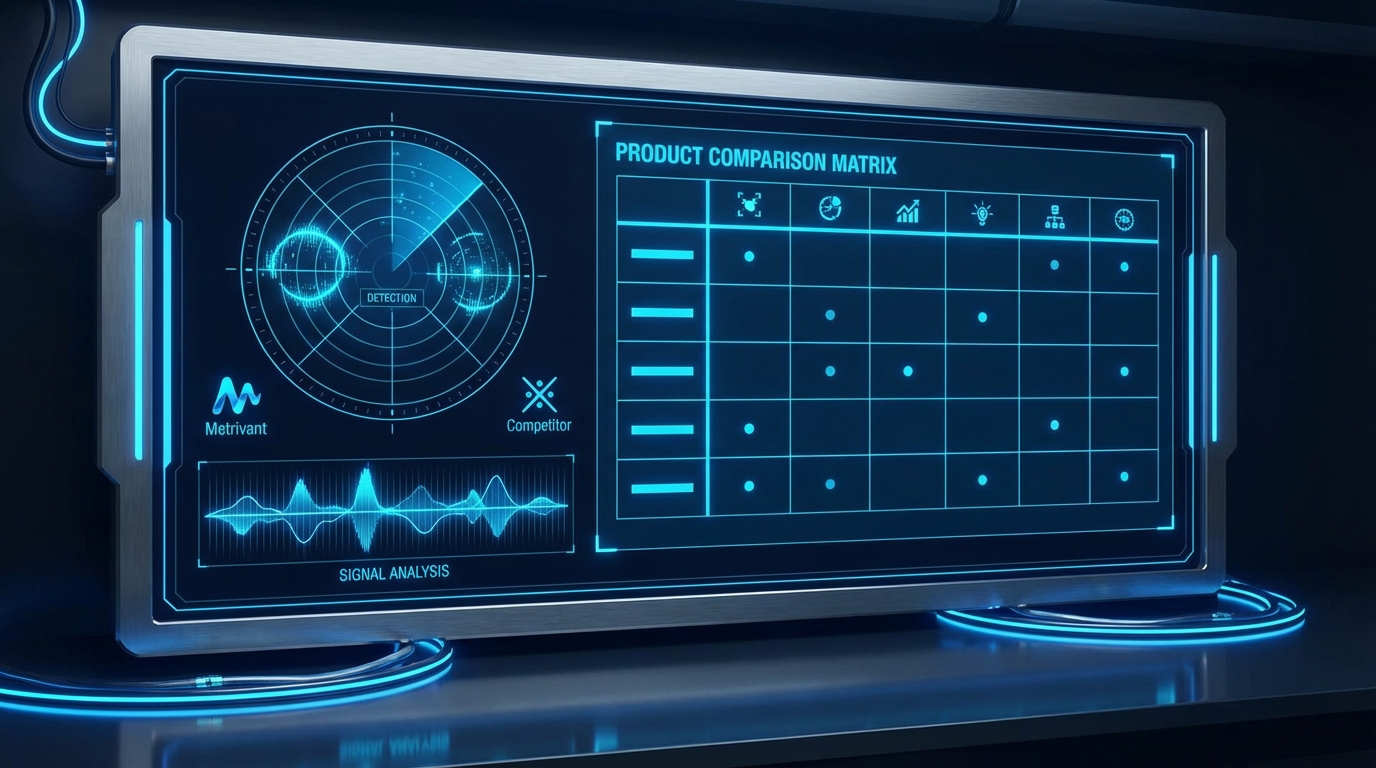
Kompyte is a competitive intelligence platform acquired by Semrush in 2021. Since the acquisition, Kompyte has shifted toward enterprise bundle pricing and deep Semrush integration, losing its standalone self-serve value proposition. Metrivant is the deterministic, self-serve alternative — starting at $9/month, no enterprise contract required, with a fully inspectable evidence chain for every signal it generates.
If you are evaluating Kompyte alternatives in 2026, the decision context has changed significantly from what it was in 2020 or even 2022. Kompyte no longer operates as an independent self-serve product with transparent pricing. It is now part of Semrush’s enterprise intelligence suite — which means the purchasing process, the pricing model, and the feature direction have all shifted toward large enterprise teams with existing Semrush relationships.
This comparison covers what Kompyte is, what changed after the Semrush acquisition, who Kompyte still serves well, and where Metrivant is the stronger choice for self-serve B2B SaaS teams who need deterministic competitive intelligence without an enterprise contract.
> **Quick Answer:** Kompyte (now part of Semrush) is a competitive intelligence platform that shifted toward enterprise bundle pricing and deep Semrush integration after its 2021 acquisition. Metrivant is the self-serve deterministic alternative: starting at $9/month, no enterprise contract, with a fully inspectable evidence chain for every signal. Kompyte is the right choice if your team already uses Semrush at the enterprise tier and needs competitive intelligence embedded in that workflow. Metrivant is the right choice if you need a standalone, evidence-first competitive intelligence system without bundle dependencies.
## What Is Kompyte?
Kompyte was founded in 2013 as a standalone competitive intelligence platform designed to help marketing and sales teams track competitor website changes, monitor competitor content, and generate battlecard content automatically. The product was notable for its battlecard automation features and its competitor website monitoring coverage.
In 2021, Semrush acquired Kompyte and integrated it into the Semrush App Center as part of Semrush’s broader push toward becoming an all-in-one digital intelligence platform. The acquisition positioned Kompyte’s competitive intelligence capabilities alongside Semrush’s existing SEO, content marketing, and advertising intelligence suite.
### What the Semrush Acquisition Changed
**Pricing structure.** Pre-acquisition, Kompyte offered accessible self-serve pricing tiers that allowed individual PMMs and small teams to get started independently. Post-acquisition, Kompyte’s pricing is embedded within Semrush’s enterprise tier offerings. Standalone pricing is no longer publicly listed — a meaningful signal that the product is now primarily sold to enterprise Semrush accounts rather than independent buyers.
**Purchasing process.** Buying Kompyte now involves Semrush’s enterprise sales process. For a team that is already a Semrush enterprise customer, this is a natural upsell. For a team that is not a Semrush customer and does not need Semrush’s broader digital marketing suite, it introduces a significant purchasing barrier: you must now evaluate and potentially purchase an all-in-one platform rather than a focused competitive intelligence tool.
**Feature direction.** Kompyte’s product development since the acquisition has focused primarily on deeper Semrush integration — connecting competitive intelligence signals to Semrush’s SEO and advertising data, and building workflows that assume the broader Semrush ecosystem. Features designed for teams that do not use Semrush have received less investment.
**Target customer.** Kompyte’s target customer in 2026 is a large marketing or product team at an enterprise company that already uses Semrush at scale. Teams that need a standalone competitive intelligence system — without the broader digital marketing suite — are increasingly misaligned with Kompyte’s product direction.
## What Kompyte Does Well
Before discussing where Metrivant is the stronger choice, it is important to be accurate about where Kompyte’s approach produces value.
**Deep Semrush integration.** For teams that are already heavy Semrush users, Kompyte’s integration with Semrush’s organic search data, keyword tracking, and advertising intelligence is genuinely valuable. The ability to connect a competitor’s website change signal with their organic ranking movements in a single platform is a useful workflow for SEO-heavy competitive analysis.
**Battlecard automation.** Kompyte’s battlecard generation features are well-developed. The system can automatically populate battlecard templates from detected competitor changes, which reduces the manual effort required to keep sales enablement materials current.
**Large enterprise CI programs.** For a team managing competitive intelligence for 50+ competitors across multiple product lines, Kompyte’s enterprise feature set — including Salesforce integration, dedicated onboarding, and analyst support — provides capabilities that self-serve tools do not match.
## Where Metrivant Is the Better Choice
### For Self-Serve Teams Without a Semrush Dependency
Metrivant starts at $9/month for the Analyst plan (10 competitors, weekly digest, 30-day history) and $19/month for the Pro plan (25 competitors, real-time alerts, 90-day history, strategic movement analysis). There is no enterprise contract, no minimum commitment, and no requirement to purchase an adjacent platform to unlock the core functionality.
For a 3-10 person SaaS team where the PMM or founder is running competitive intelligence personally, Metrivant’s self-serve model is purpose-built for the use case. You can add your top 10 competitors, start receiving verified signals, and have your first battlecard update within 24 hours of signup — without a sales call or a procurement process.
### For Evidence-First Competitive Intelligence
This is the core differentiator between Metrivant and every competitive intelligence tool that relies on AI summarization — including Kompyte’s AI-generated battlecard content.
Kompyte’s battlecard automation works by processing detected competitor changes through an AI layer that generates copy. The output is polished and structured. The problem is that the underlying detection is not fully inspectable — you cannot trace a specific battlecard claim to the exact page diff that produced it, see the before-and-after text, and verify the claim directly.
Metrivant’s approach is deterministic first. Every signal traces to a specific page diff: the exact text that was present before the change, the exact text that replaced it, the URL of the page, the timestamp of the detection, and the confidence score of the classification. The AI intelligence layer (strategic implication and recommended action) sits on top of this verified foundation — it interprets the evidence, it does not replace it.
In March 2026, Metrivant detected a coordinated move by Mercury: classified as feature_launch combined with positioning_shift, resolving to product_expansion and market_reposition. The full evidence chain was inspectable — specific page diffs for both the product and positioning pages, before-and-after excerpts, classification, confidence score, strategic implication, and one recommended action. A PMM using Metrivant could show a sales rep exactly what Mercury changed, in Mercury’s own words, and use that as the proof point behind an updated battlecard claim. That level of inspectability is not available in AI-generated battlecard systems.
### For Real-Time Pricing and Feature Detection
Metrivant’s 8-stage pipeline monitors competitor pricing pages, changelog pages, and feature pages on cadences designed for the change velocity of those page types: hourly for pricing and changelog pages (high_value cadence), every three hours for feature and homepage content (standard cadence).
Pricing intelligence is where evidence-first detection matters most. A competitor’s pricing change discovered 48 hours after it went live is significantly more valuable than one discovered weeks later through an AI summary. For B2B SaaS teams where competitor pricing is a deal-stage factor, the latency of detection directly affects deal outcomes.
## Comparison Table: Metrivant vs Kompyte (by Semrush)
| Dimension | Metrivant | Kompyte (by Semrush) |
|—|—|—|
| Starting price | $9/month (Analyst) | Embedded in Semrush enterprise tier |
| Standalone product | Yes | No — requires Semrush |
| Evidence chain | Fully inspectable page diff per signal | AI-generated, not fully traceable |
| Detection method | Deterministic 8-stage pipeline | AI-assisted monitoring |
| Pricing page cadence | Hourly | Not publicly specified |
| Battlecard support | Evidence-backed signal output | Automated AI battlecard generation |
| Semrush integration | None | Native |
| Target team size | 1-50 (self-serve focus) | 50+ (enterprise focus) |
| Onboarding | Self-serve, live within 24h | Enterprise sales process |
| Salesforce integration | Not yet | Yes |
| Signal evidence | Before/after page diff, confidence score | AI summary |
## Who Should Choose Kompyte
Kompyte is the right choice for your team if:
– You are already a Semrush enterprise customer and the added cost of the Kompyte integration is within your existing budget
– Your CI program requires Salesforce integration for delivering signals directly into sales workflows
– You need dedicated analyst support and enterprise onboarding for a large, complex competitive program
– Your team’s competitive analysis is deeply intertwined with SEO and advertising intelligence that Semrush already provides
## Who Should Choose Metrivant
Metrivant is the right choice for your team if:
– You need a standalone competitive intelligence system without an enterprise suite commitment
– You are a PMM, strategy lead, or founder running CI personally and need to start within a day, not a quarter
– Evidence chain integrity matters to you — you need to be able to show a sales rep exactly what the competitor changed, not just a summary of what an AI inferred
– You want pricing, feature, and positioning alerts on the cadence that matches competitor move velocity, not a weekly batch summary
– Your budget is $9-19/month rather than enterprise tier
Metrivant monitors 777 pages across 150 competitors, with verified signals going to PMMs and founders who need to move before the next deal cycle. You can [start your free trial at metrivant.com/trial](https://metrivant.com/trial?utm_source=blog&utm_medium=article&utm_campaign=kompyte-alternative) and have your first competitors monitored within 24 hours.
For a broader comparison across the full competitive intelligence tool landscape — including Klue, Crayon, Kompyte, and self-serve options — see the [best competitive intelligence tools for 2026](https://metrivant.blog/?p=52).
## Frequently Asked Questions
### What is Kompyte and who owns it now?
Kompyte is a competitive intelligence platform originally founded in 2013 and acquired by Semrush in 2021. Since the acquisition, Kompyte is sold as part of Semrush’s enterprise suite rather than as an independent self-serve product. Kompyte’s pricing is no longer publicly listed and the platform is primarily targeted at large organizations with existing Semrush relationships.
### How does Metrivant differ from Kompyte as a Kompyte alternative?
The primary differences are pricing model, evidence approach, and target customer. Metrivant starts at $9/month as a fully self-serve product — no enterprise contract, no requirement to purchase an adjacent platform. Metrivant’s detection is deterministic: every signal traces to a specific page diff with before-and-after text, confidence score, and strategic implication that any team member can inspect. Kompyte’s battlecard automation uses AI generation that produces polished output but without the same level of source traceability.
### Is Kompyte worth it if you don’t already use Semrush?
For most B2B SaaS teams evaluating competitive intelligence tools independently of Semrush, Kompyte is difficult to justify in 2026. The purchasing process requires engagement with Semrush’s enterprise sales team, the pricing is not transparent, and the product’s feature direction assumes a Semrush workflow that teams without Semrush do not have. If your primary need is competitive intelligence with verified evidence, a standalone tool like Metrivant provides a more direct path to value at a lower cost.
### How does Metrivant handle pricing and feature change detection?
Metrivant monitors competitor pricing pages and changelog pages on an hourly cadence (high_value) and feature and homepage content every three hours (standard). When a page changes, Metrivant’s 8-stage pipeline generates a signal that includes the specific page diff (before-and-after text), the signal type classification (pricing_change, feature_launch, market_repositioning, etc.), a confidence score, the strategic implication, and one recommended action. The evidence chain is fully inspectable by any member of your team.
### What should I look for when evaluating a Kompyte alternative?
Four criteria matter: (1) can you start without an enterprise sales process and a procurement cycle? (2) does every signal trace to an inspectable source — the specific page that changed and exactly what changed? (3) what is the detection cadence for pricing and feature pages — are changes surfaced within hours or within days? (4) is the tool purpose-built for competitive intelligence, or is it a competitive module within a broader platform that serves a different primary use case?