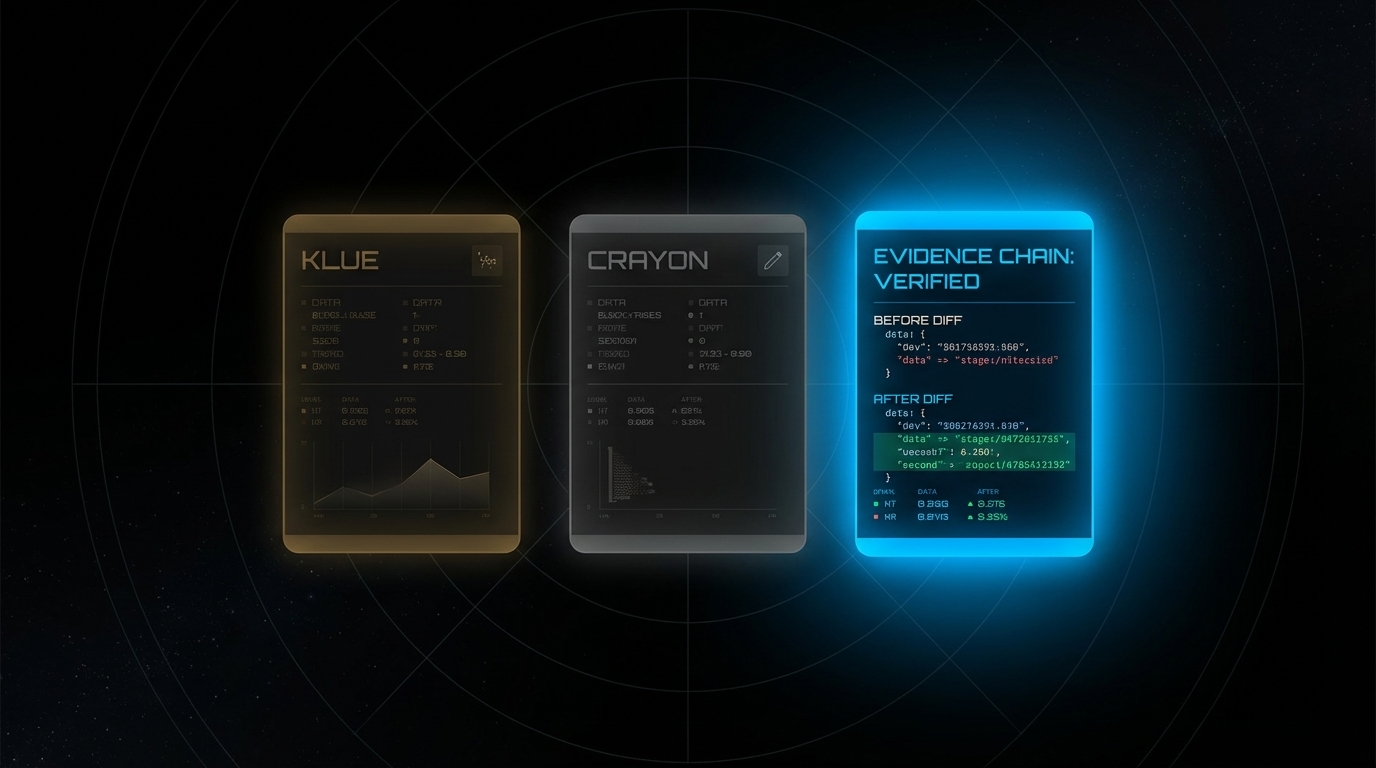
If you search for competitive intelligence software in 2026, two names come up on every shortlist: Klue and Crayon. Both are well-funded, have enterprise customers, and have been in the market long enough to build brand recognition. But neither was built around one question that matters more than any other when evaluating a CI tool.
Can you see the evidence behind each signal?
<div style="background:#0E1420; border-left:4px solid #00B4FF; padding:16px 20px; margin:24px 0; font-size:0.95em;">
<strong style="color:#00B4FF; font-size:0.8em; letter-spacing:0.06em; text-transform:uppercase;">Quick Answer</strong><br>
<p style="color:#e2e8f0; margin:8px 0 0; line-height:1.6;">Klue and Crayon are enterprise CI platforms that surface intelligence through AI summarization and multi-source aggregation. Metrivant is a newer alternative that traces every signal back to an inspectable before/after page diff. The evidence gap is significant: Klue and Crayon give you a confidence score; Metrivant gives you the source text that changed.</p>
</div>
> Quick Answer: Klue and Crayon are built for teams with large sales orgs and enterprise budgets. Metrivant is built for teams that need evidence behind every signal, starting at $9/month.
This comparison runs all three through one test: the evidence chain. A signal has an evidence chain if the user can open the specific page that changed, see the text before the change, see the text after, and read the classifier's reasoning. That is the bar.
Why the Evidence Question Matters More in 2026
Google's March 2026 core update is three-quarters through its rollout. The early pattern in ranking shifts is consistent: pages with verifiable, specific claims backed by real sources are gaining. Pages built on confident AI summaries with no traceable source are losing ground.
The same tension exists inside competitive intelligence. Most CI tools produce summaries. The team acts on them. Nobody checks whether the summary accurately reflects a real change. In competitive deals, that gap costs you.
The best competitive intelligence tools in 2026 are the ones that treat the evidence layer as a first-class product requirement.
Klue (2026 Review)
Klue is an enterprise competitive intelligence platform used primarily by sales and product marketing teams at mid-market and enterprise companies. Its core workflow: signal aggregation, battlecard generation, and delivery through Slack and Salesforce integrations.
Where Klue works well
The integration depth is real. For a 200-person sales org that lives in Salesforce, Klue's ability to surface competitive context in the CRM without requiring reps to check a separate tool has genuine value.
Battlecard management is polished. Teams with a dedicated CI analyst can maintain a library of competitive assets and push updates through a workflow most salespeople will actually use.
Where Klue falls short
Klue does not show you the evidence chain behind each signal. When a change surfaces, you see a summary and a source link. There is no before/after text, no classifier reasoning, no diff view.
This creates a manual verification step for every signal your team acts on. For teams moving fast on competitive deals, this compounds.
Pricing is also a barrier. Enterprise contracts start at approximately $15,000 per year, with most deployments significantly higher.
Crayon (2026 Review)
Crayon approaches competitive intelligence from a marketing and positioning angle. It monitors competitor websites, ad campaigns, product pages, and messaging, then surfaces those changes in a dashboard built primarily for product marketers and marketing leaders.
Where Crayon works well
Breadth of coverage. Crayon monitors across web properties, ads, and marketing content, which makes it useful for teams trying to understand a competitor's go-to-market positioning over time.
The reporting layer is functional. Teams can generate weekly competitive briefings without heavy manual effort.
Where Crayon falls short
The same structural issue applies: Crayon uses AI summarization to classify and present signals. There is no native before/after diff view, no page-level evidence chain, no classifier reasoning to inspect.
The pricing structure mirrors Klue, making it effectively inaccessible to Series A companies and most Series B teams.
Metrivant (2026 Review)
Metrivant is built on a different premise. Rather than aggregating signals from multiple external sources, it builds a monitored page index of specific competitor URLs and runs a deterministic 8-stage detection pipeline against every page it tracks.
Every signal includes a full evidence chain: the URL that changed, the before-text, the after-text, the signal classification, a confidence score, a strategic implication, and one recommended action.
Where Metrivant works well
The evidence chain is fully inspectable. No other tool in this comparison puts before/after page diffs in the user interface at the signal level.
Crawl cadence is tight. Pricing pages and changelog pages run on an hourly cycle. A competitor pricing change can surface as a verified, classified signal within hours of going live.
As of April 2026, Metrivant monitors 795 pages across 150 competitors. At $9/month for the Analyst plan and $19/month for Pro, it is accessible at any funding stage.
Where Metrivant falls short
Metrivant monitors web properties only. It does not aggregate news, job board signals, or G2 reviews the way Klue and Crayon do. Teams that need a full multi-source aggregation layer will need to combine it with additional tooling.
The platform is newer, with fewer customer references than Klue or Crayon.
Proof: What the Evidence Chain Looks Like in Practice
In March 2026, Metrivant's pipeline detected a coordinated move by Mercury, the B2B fintech company. The system classified it as feature_launch and positioning_shift, resolving to product_expansion and market_reposition. The full evidence chain was inspectable: the specific pages that changed, the before and after text, the confidence score (0.91), the strategic implication, and a single recommended action.
A PMM monitoring Mercury through Metrivant would have updated the competitive battlecard that day. Without CI infrastructure, the move would have surfaced weeks later, in a loss debrief.
That is the output difference. Klue and Crayon produce a summary. Metrivant produces evidence.
Feature Comparison
| Capability | Klue | Crayon | Metrivant |
|---|---|---|---|
| Before/after page diff per signal | No | No | Yes |
| Inspectable evidence chain | No | No | Yes |
| Hourly pricing page monitoring | No | No | Yes |
| One recommended action per signal | No | No | Yes |
| Multi-source aggregation | Yes | Yes | No |
| Battlecard management workflow | Yes | Yes | No |
| CRM integration (Salesforce, Slack) | Yes | Yes | No |
Pricing Comparison
| Klue | Crayon | Metrivant | |
|---|---|---|---|
| Entry price | ~$15,000/yr | ~$15,000/yr | $9/month |
| Mid tier | Custom | Custom | $19/month |
| Enterprise | Custom | Custom | Custom |
Which One Is Right for Your Team
Use Klue if you are at a company with a dedicated CI function, a large sales org that needs battlecards in CRM, and budget for an enterprise contract.
Use Crayon if your primary need is tracking competitor marketing and positioning changes at scale, and you have the budget for annual pricing.
Use Metrivant if you need evidence behind every signal, you are monitoring a specific set of priority competitors, or you are not ready to commit to an enterprise contract. The Metrivant vs Klue and Metrivant vs Crayon comparisons go deeper on specific capability gaps.
To see the evidence chain in action, start a free trial at Metrivant.
FAQ
What is the main difference between Klue and Crayon?
Klue is primarily a sales enablement tool built around battlecard management and CRM integration. Crayon focuses more on marketing and positioning intelligence. Both surface signals through AI summarization without showing users the specific page text that changed.
How does Metrivant differ from Klue and Crayon?
Metrivant runs a deterministic detection pipeline against a monitored set of competitor URLs and generates a full evidence chain for every signal. Users see the before-text, the after-text, the classifier's reasoning, and one recommended action. Klue and Crayon generate AI summaries without native before/after diff views.
Is Metrivant a replacement for Klue or Crayon?
For teams using Klue or Crayon primarily for battlecard management and multi-source aggregation, Metrivant is a supplement rather than a direct replacement. For teams that need evidence-backed signals from competitor websites, Metrivant provides capabilities the other two do not offer, at a fraction of the price.
Can a solo PMM or small team use any of these tools?
Klue and Crayon require enterprise contracts, making them impractical for most teams under Series C. Metrivant's $9/month Analyst plan is designed for a single PMM tracking 10 competitors. The Radar view and weekly digest are built for 15-30 minutes of weekly review time.
What should I look for when choosing a competitive intelligence tool?
Start with one question: can the tool show you the evidence behind each signal? That means seeing which page changed, what it said before, and what it says now. If you cannot answer that question from within the tool, you are trusting a model's interpretation of a change you cannot verify.
<script type="application/ld+json">
{
"@context": "https://schema.org",
"@graph": [
{
"@type": "Article",
"headline": "Klue vs Crayon vs Metrivant (2026): Which Competitive Intelligence Tool Actually Shows Its Work?",
"description": "A direct comparison of Klue, Crayon, and Metrivant on the evidence-chain test. Which CI tool can show you the before/after diff behind every signal?",
"datePublished": "2026-04-02",
"author": {"@type": "Organization", "name": "Metrivant"},
"publisher": {"@type": "Organization", "name": "Metrivant", "url": "https://metrivant.com"}
},
{
"@type": "FAQPage",
"mainEntity": [
{
"@type": "Question",
"name": "What is the main difference between Klue and Crayon?",
"acceptedAnswer": {"@type": "Answer", "text": "Klue is primarily a sales enablement tool built around battlecard management and CRM integration. Crayon focuses more on marketing and positioning intelligence. Both surface signals through AI summarization without showing users the specific page text that changed."}
},
{
"@type": "Question",
"name": "How does Metrivant differ from Klue and Crayon?",
"acceptedAnswer": {"@type": "Answer", "text": "Metrivant runs a deterministic detection pipeline against a monitored set of competitor URLs and generates a full evidence chain for every signal. Users see the before-text, the after-text, the classifier's reasoning, and one recommended action. Klue and Crayon generate AI summaries without native before/after diff views."}
},
{
"@type": "Question",
"name": "Is Metrivant a replacement for Klue or Crayon?",
"acceptedAnswer": {"@type": "Answer", "text": "For teams using Klue or Crayon primarily for battlecard management and multi-source aggregation, Metrivant is a supplement rather than a direct replacement. For teams that need evidence-backed signals from competitor websites, Metrivant provides capabilities the other two do not offer, at a fraction of the price."}
},
{
"@type": "Question",
"name": "Can a solo PMM or small team use any of these tools?",
"acceptedAnswer": {"@type": "Answer", "text": "Klue and Crayon require enterprise contracts, making them impractical for most teams under Series C. Metrivant's $9/month Analyst plan is designed for a single PMM tracking 10 competitors. The Radar view and weekly digest are built for 15-30 minutes of weekly review time."}
},
{
"@type": "Question",
"name": "What should I look for when choosing a competitive intelligence tool?",
"acceptedAnswer": {"@type": "Answer", "text": "Start with one question: can the tool show you the evidence behind each signal? That means seeing which page changed, what it said before, and what it says now. If you cannot answer that question from within the tool, you are trusting a model's interpretation of a change you cannot verify."}
}
]
}
]
}
</script>