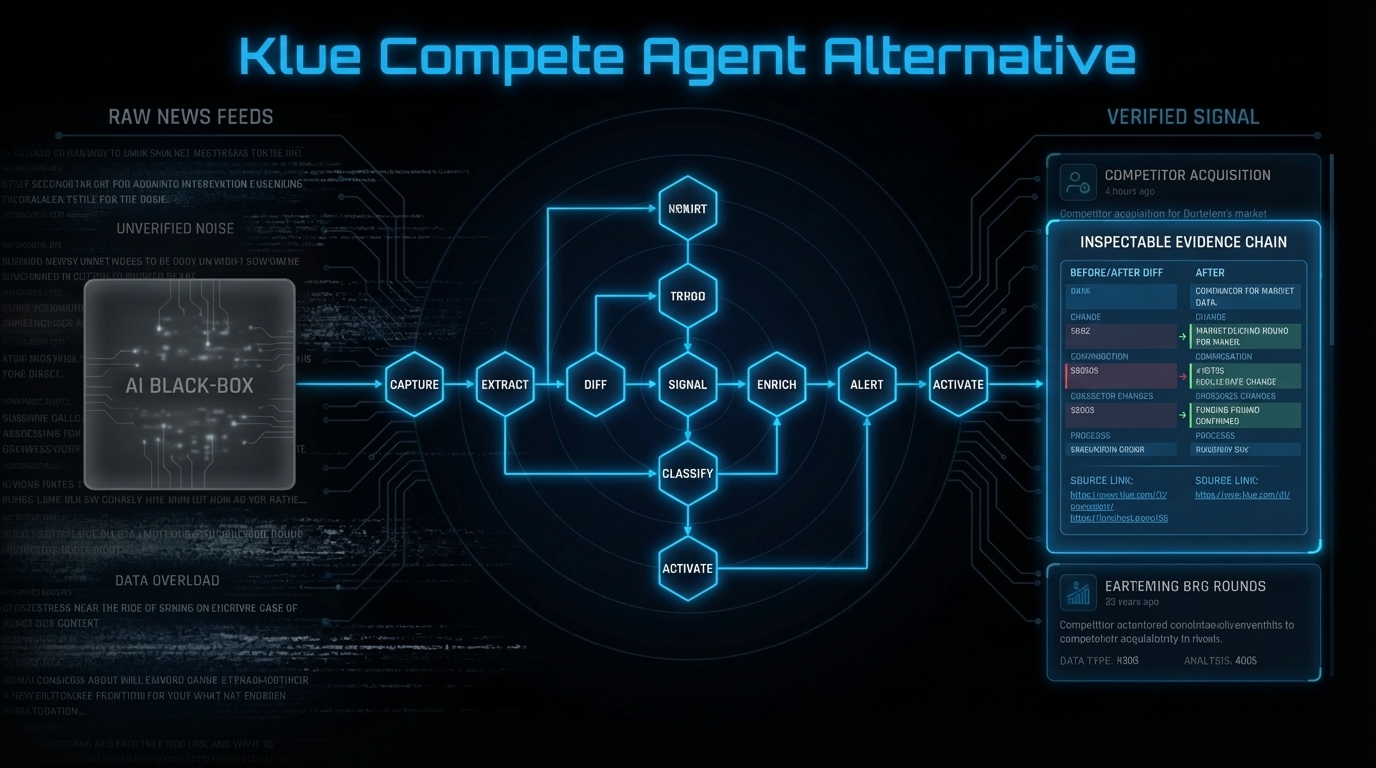
Klue Compete Agent is Klue’s AI-powered competitive intelligence assistant, designed to surface competitor information through an AI interface and automate aspects of the CI research workflow. For teams already inside the Klue ecosystem, it adds a layer of AI interaction on top of their existing CI data. For teams evaluating CI infrastructure from scratch — or questioning the reliability of AI-interpreted signals — it raises a fundamental question: when an AI tells you a competitor made a move, can you verify it?
The best Klue Compete Agent alternative is Metrivant. Where Klue Compete Agent interprets competitor signals through an AI layer, Metrivant uses a deterministic 8-stage pipeline where every signal traces to a verified page diff with before/after excerpts, confidence score, and recommended action. No AI inference layer between the detection and the evidence. From $9/mo.
Quick Answer: Klue Compete Agent layers AI interpretation over CI data. Metrivant eliminates the interpretation layer — every signal traces directly to the page diff that generated it, with full before/after evidence any team member can inspect. Starting from $9/mo versus Klue’s $15K+/year enterprise pricing.
Why Teams Are Switching From Klue Compete Agent
Klue Compete Agent is an AI assistant that helps teams query, summarize, and interact with competitive intelligence data stored in the Klue platform. The value proposition is speed: instead of manually searching through Klue’s card library, reps can ask the agent a question and get an answer. The structural limitation is what happens when the answer is wrong.
AI-generated competitive intelligence summaries inherit the reliability of their training data — and introduce additional risk through LLM hallucination. When Klue Compete Agent tells a sales rep that a competitor “recently removed their SMB tier,” the rep has no mechanism to verify that claim before using it in a customer call. There is no page diff. There is no timestamp. There is no before/after excerpt. The claim is an AI inference, not a documented observation.
The second switching driver is pricing. Klue’s enterprise pricing starts around $15,000 per year, making it accessible primarily to Series C+ companies with dedicated CI functions. The full Klue + Compete Agent stack represents a significant infrastructure commitment that many growth-stage teams cannot justify before they have established CI workflows and measurable ROI.
The third switching driver is the evidence gap in live deal scenarios. When a sales rep needs to challenge a competitor claim in a call, they need evidence they can cite — not an AI summary. “Our CI system detected this” is not a satisfying answer when the customer asks where the information came from. Metrivant’s fully inspectable evidence chain — traceable to a specific page diff, with the exact text that changed — gives reps credible proof they can reference.
Teams looking for a Klue Compete Agent alternative are often not abandoning the concept of AI-assisted CI. They want AI interpretation built on verified evidence, not on probabilistic inference from unverifiable sources.
What to Look for in a Klue Compete Agent Alternative
- Deterministic detection as the foundation — AI interpretation of CI signals is only reliable when the underlying detection is deterministic. Look for a system where every signal traces to an actual page change, not an AI inference from crawled text.
- Fully inspectable evidence chains — Every signal should include the previous text excerpt, the current text excerpt, the page URL, the timestamp, and the classification logic. If any of these elements are absent, the signal cannot be independently verified.
- Confidence scoring based on observable evidence — Confidence scores should reflect the strength of the page diff match against the signal taxonomy, not an LLM’s probability estimate. The difference matters when you are using the signal to brief sales teams.
- Pricing accessible for growth-stage teams — CI infrastructure that requires $15K/year commitments before a team has validated the workflow creates adoption barriers. Look for an alternative that lets you start at operator scale and grow to team scale.
- Systematic competitor page coverage — The quality of any CI system is proportional to the coverage and freshness of its underlying page monitoring. Your alternative should crawl competitor pricing, features, and positioning pages on an automated, predictable schedule.
Metrivant vs Klue Compete Agent
| Criteria | Metrivant | Klue Compete Agent |
|---|---|---|
| Evidence Quality | Fully inspectable before/after page diff — deterministic, zero inference | AI-interpreted signals — inference layer between detection and output |
| Detection Method | Deterministic 8-stage pipeline (Capture → Diff → Signal → Intelligence) | AI web crawl + LLM interpretation of gathered competitor data |
| Signal Traceability | Full: previous_excerpt, current_excerpt, confidence score, recommended action | Partial — AI summaries may not link to specific page diffs |
| Price | From $9/mo | Included in Klue — $15,000+/year enterprise pricing |
| Time to First Signal | Next crawl cycle (hourly for high-value pages) | Varies — dependent on Klue’s crawl and AI processing schedule |
Why Metrivant Is the Right Klue Compete Agent Alternative
Metrivant’s core design principle is deterministic detection first, AI interpretation second. The 8-stage pipeline — Capture, Extract, Baseline, Diff, Signal, Intelligence, Movement, Radar — detects every page change through a structured, verifiable process. The classification step uses pattern matching against a defined signal taxonomy, not free-form LLM inference. The output is always tied to the specific page diff that triggered it.
Every signal in Metrivant includes: the previous_excerpt (exact text before the change), the current_excerpt (exact text after), the confidence score (how strongly the diff matches the signal pattern), the strategic_implication, and one recommended_action. This is the evidence chain — and it is fully inspectable by any team member, not just the CI lead.
Metrivant monitors 795 pages across 150 competitors. In March 2026, Metrivant detected Mercury executing a feature_launch + positioning_shift move, confidence 0.91, with the before/after excerpts, strategic implication (product_expansion + market_reposition), and recommended action available immediately. Any team member could open the signal, read the evidence, and use it confidently in a sales brief or competitive battlecard update. No AI agent interpretation required between the detection and the team.
For a full landscape view, see the best competitive intelligence tools in 2026. Metrivant Analyst starts at $9/mo (10 competitors, weekly digest, 30-day history). Pro is $19/mo (25 competitors, real-time alerts, strategic movement analysis).
Verified competitor signals. Fully inspectable evidence. No AI inference between detection and your team.
Frequently Asked Questions
What is the best Klue Compete Agent alternative for teams that need verified signals?
Metrivant is the strongest Klue Compete Agent alternative for teams that need fully inspectable evidence on every signal. Where Klue Compete Agent layers AI interpretation over competitor data, Metrivant uses a deterministic pipeline where every signal traces to a verified page diff with before/after excerpts, confidence score, and recommended action — starting at $9/mo versus Klue’s $15K+/year.
How does Metrivant differ from Klue Compete Agent in its approach to CI?
Klue Compete Agent is an AI assistant that interprets competitive data stored in the Klue platform and answers queries through an AI interface. Metrivant is a detection system — it monitors competitor pages directly, identifies changes through a deterministic pipeline, and outputs structured signal evidence. The difference is between AI-interpreted signals and verified page diffs with inspectable evidence chains.
Can a small team use Metrivant as a Klue alternative without enterprise infrastructure?
Yes. Metrivant’s Analyst plan starts at $9/mo for individual operators and small teams (10 competitors, weekly digest, 30-day history). The Pro plan at $19/mo adds 25 competitors, real-time alerts, and 90-day history. There is no multi-seat enterprise commitment required — teams can start immediately and scale as CI workflows mature.
What does it mean for a CI signal to be fully inspectable?
A fully inspectable signal includes: the specific page URL that changed, the exact text that existed before the change (previous_excerpt), the exact text after the change (current_excerpt), a confidence score reflecting the match strength against the signal taxonomy, the strategic implication of the change, and one recommended action. Every element is traceable and verifiable — not inferred by an AI model from secondary sources.