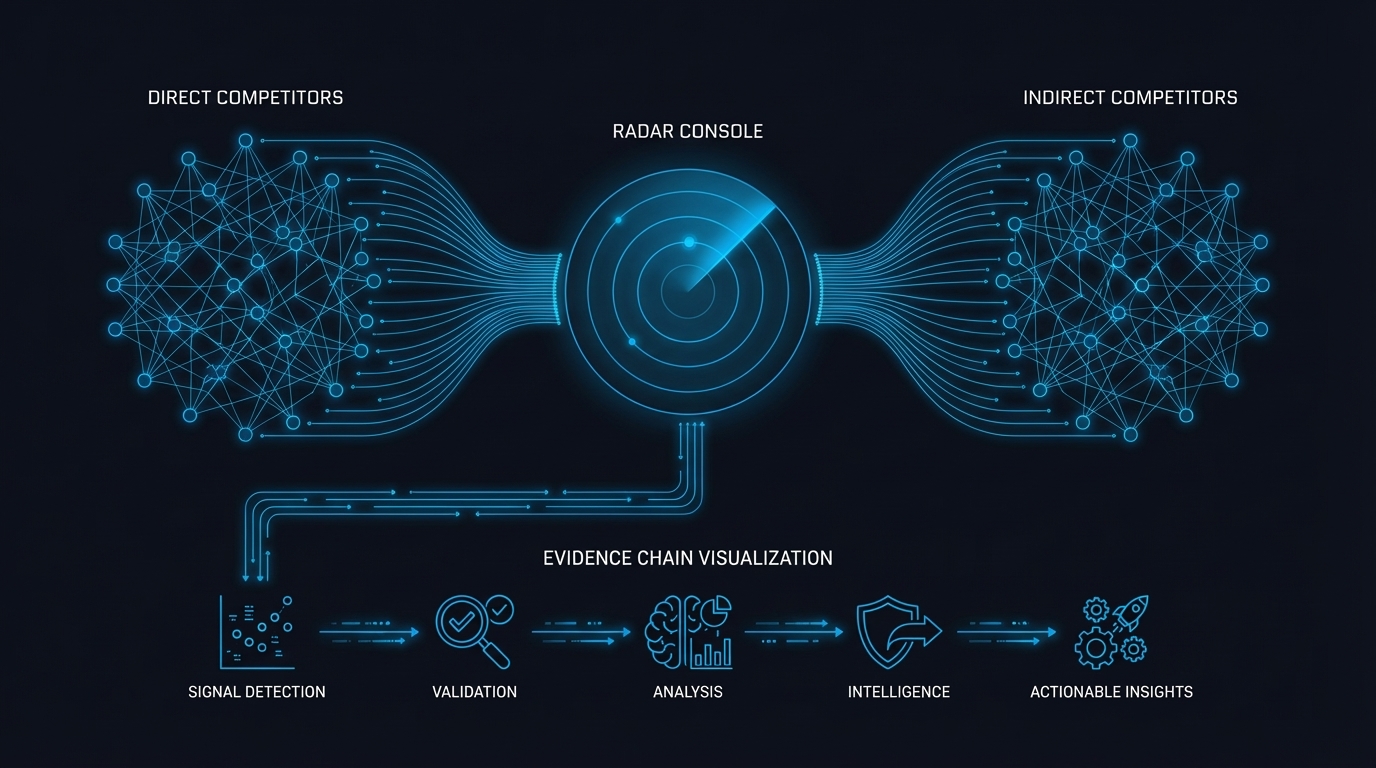
Most competitor analysis frameworks start with a sorting exercise: put your competitors into two buckets, direct and indirect, then focus on the direct ones. It is a reasonable starting point. But it is also where most teams stop, which is a mistake. Indirect competitors become direct ones. Fast. And when they do, you find out from a sales rep who lost a deal, not from a competitor monitoring system that caught the transition 60 days earlier. This guide covers how to identify and classify your direct and indirect competitors accurately, when that classification breaks down, and what signal-based tracking can tell you that category labels cannot.
QUICK ANSWER
Direct competitors target the same customers with the same solution. Indirect competitors solve the same problem with a different approach or serve an overlapping segment. The classification matters for prioritization, but the more important question is which indirect competitors are signaling a move toward direct competition through verified page changes, job listings, or pricing adjustments.
> **Quick Answer:** Direct competitors target the same customer with a comparable solution. Indirect competitors solve the same customer problem through a different approach or partially overlap on the customer segment. Both types require monitoring, but indirect competitors moving toward direct competition are often the highest-risk blind spot for B2B SaaS teams. Verified signal detection catches that transition before it shows up in a loss debrief.
—
## What Are Direct Competitors?
Direct competitors sell the same type of solution to the same type of customer. If two companies are both trying to get the same VP of Sales to pay for the same category of product, they are direct competitors.
For a B2B SaaS competitive intelligence platform, Klue and Crayon are direct competitors. Same category, same buyers, similar pricing tier, similar feature set. Deals are competitive. Reps need battlecards. Win-loss data shows them explicitly.
Direct competitors are easy to identify because:
– They appear in your loss reports by name
– Prospects mention them in discovery calls
– They rank for the same search keywords you do
– Their pricing pages target the same budget holder
—
## What Are Indirect Competitors?
Indirect competitors solve the same underlying problem your customer has, but through a different mechanism. They may target a slightly different segment, use a different go-to-market motion, or approach the problem from an adjacent product category.
For a competitive intelligence platform, indirect competitors include:
– Google Alerts (free, basic change monitoring)
– LinkedIn Sales Navigator (manual research workflow)
– Generic LLMs like ChatGPT (ad hoc competitive research prompts)
– Social listening tools used for brand tracking
– Market research firms providing quarterly reports
None of these are direct competitors in the traditional sense. But they all compete for the same budget line and the same 4 hours of PMM attention on a Tuesday afternoon.
The problem with indirect competitors is not that they are hard to identify. It is that they are easy to underestimate, right up until they are not.
—
## When Indirect Becomes Direct: The Transition Signal
The most dangerous competitive scenario in B2B SaaS is not when a direct competitor launches a new feature. It is when an indirect competitor decides to come after your core market.
Visualping started as a generic page monitoring tool. It sits in Metrivant’s indirect competitor set. But if Visualping launched a competitive intelligence-specific pricing tier, added battlecard generation, and started bidding on “klue alternative” as a search keyword, the transition to direct competition would be underway. A team with no monitoring infrastructure would find out when a prospect mentioned it in a call. A team with verified page change detection would see the pricing page update, the new feature announcement, and the keyword shift weeks before that call.
That is the practical value of tracking indirect competitors with the same rigor you apply to direct ones. You are not watching for what they are today. You are watching for what they are signaling they plan to become.
—
## How to Build a Complete Competitor Classification System
### Step 1: Start with the loss report
Pull the last 90 days of CRM loss data. Every competitor named in a lost deal belongs in the direct competitor tier, regardless of how you previously classified them. Loss data is ground truth.
### Step 2: Map the solution substitutes
Ask: what does my customer use instead of my product when they do not buy from us? Free alternatives, manual workflows, adjacent tools, and “do nothing” all count. These are indirect competitors by behavior, even if they do not market themselves as being in your category.
### Step 3: Check search overlap
Run a keyword gap analysis against competitors you suspect are adjacent. Tools like Ahrefs or SEMrush will show which keywords you both rank for. High overlap on commercial-intent keywords (like “competitive intelligence software” or “competitor monitoring tool”) indicates a closer competitive relationship than the product category suggests.
### Step 4: Monitor for transition signals
For each competitor in your classification matrix, define what a “transition signal” looks like. For an indirect competitor, a transition signal might be:
– A pricing page restructure that adds a feature tier matching your core product
– A job listing for a product manager with your category keywords in the description
– A blog post targeting your primary commercial keyword
– A partnership announcement with a company in your distribution channel
These signals exist in the public record. They show up as page changes, new content, and updated metadata. Manual monitoring catches them weeks after the fact, if at all.
—
## The Classification Matrix: A Working Framework
| Competitor type | Definition | Example (CI space) | Monitoring priority |
|—|—|—|—|
| Direct | Same solution, same buyer, same budget | Klue, Crayon, Kompyte | High — real-time |
| Adjacent | Overlapping buyer, partial solution overlap | Salesforce CI features, Gong intel layer | Medium — weekly |
| Indirect | Same problem, different mechanism | Google Alerts, ChatGPT, Visualping | Medium — monthly |
| Emerging | New entrant with credible category ambition | Funded early-stage CI startups | Medium — quarterly |
| Aspirational | Not competing yet but has the resources to enter | Large CRM vendors | Low — trigger-based |
The matrix is useful, but it is a snapshot. Without ongoing monitoring, any competitor can shift tiers without you noticing.
—
## Why the Direct/Indirect Distinction Matters Less Than You Think
Here is the uncomfortable truth about competitor classification: by the time you have sorted everyone into the right bucket, you have already answered the wrong question.
The right question is not “which type of competitor is this?” It is “which competitor is moving right now, and what are they moving toward?”
A direct competitor that has not changed their pricing page in 6 months is less urgent than an indirect competitor that just restructured their homepage to lead with a feature that competes directly with your core product. Category does not determine threat level. Movement does.
This is the shift from competitor classification to competitor intelligence. Classification is static. Intelligence is continuous.
—
## How Metrivant Monitors Direct and Indirect Competitors
Metrivant’s detection pipeline does not distinguish between direct and indirect competitors. The system treats every monitored page the same: capture the page state, extract content, establish a baseline, detect changes, classify the type of move, and surface the evidence chain.
In March 2026, Metrivant detected Mercury making a coordinated product and positioning move in the fintech space. The system classified it as feature_launch combined with positioning_shift, with a confidence score of 0.91. The before/after page excerpts were inspectable. A PMM team using Metrivant updated their battlecard the same day and walked into their next fintech deal with current competitive positioning. Without signal infrastructure, the move would have surfaced weeks later, in a loss debrief.
The same detection logic applies whether the competitor is in your direct tier or your indirect tier. A pricing page change from a tool you classified as “adjacent” is still a verified signal. The before/after diff still exists. The recommended action is still actionable.
Metrivant monitors 795 pages across 150 competitors. You set the competitor list. The system watches everything on it, regardless of category.
See how Metrivant detects competitor changes in the 8-stage pipeline guide and explore the broader best competitive intelligence tools comparison.
Start monitoring your full competitor set at metrivant.com/trial.
—
## Frequently Asked Questions
**What is the difference between direct and indirect competitors?**
Direct competitors offer the same type of solution to the same type of customer. Indirect competitors solve the same underlying problem through a different mechanism, serve a partially overlapping customer segment, or compete for the same budget without being in the same product category. Both types affect win rates and should be tracked, though indirect competitors are often monitored with lower frequency.
**How do you identify direct competitors for a B2B SaaS company?**
Start with your CRM loss data. Every competitor named in a lost deal is a direct competitor by definition. Then check keyword overlap using SEO tools, review G2 and Capterra comparison pages, and look at what prospects mention in discovery calls. For most B2B SaaS companies, the direct competitor list is 3 to 8 companies.
**How can you tell when an indirect competitor is becoming a direct threat?**
The clearest signals are pricing page restructures that add tiers matching your product’s core value, job listings with your category keywords, blog content targeting your primary commercial search terms, and partnership announcements in your distribution channels. These signals appear as page changes and new content before they appear in your loss reports. Automated monitoring catches them weeks earlier than manual research.
**How does Metrivant handle direct and indirect competitor monitoring?**
Metrivant applies the same 8-stage detection pipeline to all monitored pages regardless of competitor classification. Every page change produces an evidence chain with before/after excerpts, a confidence score, a signal classification, and a recommended action. You build the competitor list; Metrivant monitors everything on it. Plans start at $9/month at metrivant.com/pricing.
**How often should you update your competitor classification?**
The classification matrix should be reviewed quarterly. However, transition signals from indirect to direct competitors can appear at any time, which is why real-time monitoring of your full competitor set is more valuable than periodic classification reviews. A quarterly review of the matrix paired with continuous monitoring of page changes gives you both the strategic picture and the real-time signal layer.
Direct competitors target the same customers with the same solution. Indirect competitors solve the same problem with a different approach or serve an overlapping segment. The classification matters for prioritization, but the more important question is which indirect competitors are signaling a move toward direct competition through verified page changes, job listings, or pricing adjustments.