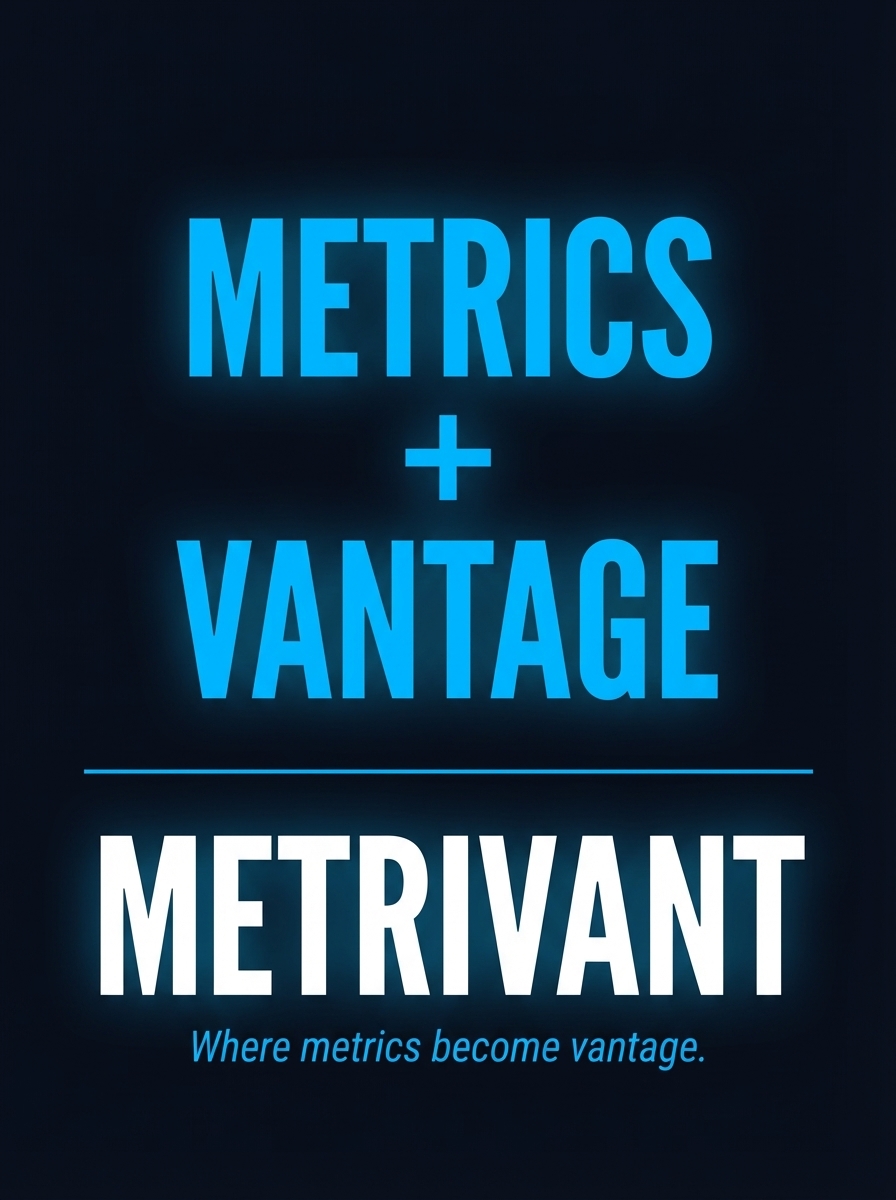
Most product names are chosen for domain availability, or because they sound vaguely technical. The name tells you nothing about the problem it solves.
Metrivant is not that kind of name.
<div style="background:#0E1420; border-left:4px solid #00B4FF; padding:16px 20px; margin:24px 0; font-size:0.95em;">
<strong style="color:#00B4FF; font-size:0.8em; letter-spacing:0.06em; text-transform:uppercase;">The Short Version</strong><br>
<p style="color:#e2e8f0; margin:8px 0 0; line-height:1.6;">Metrivant = Metrics + Vantage. The founding idea: most competitive intelligence tools give teams metrics. Confidence scores, AI summaries, change classifications. Metrivant gives you vantage over those metrics — the strategic position from which data becomes decisions.</p>
</div>
Metrics + Vantage
The name comes from two words.
Metrics. The raw material of competitive intelligence: page changes, pricing shifts, feature launches, positioning updates. Every CI tool in existence gives you metrics. They extract the change, run it through a model, and hand you a confidence score or a classification label.
Vantage. The strategic position from which those metrics become decisions. Vantage is what metrics alone cannot give you.
The gap between the two is the problem.
A metric tells you that a competitor's pricing page changed. Vantage tells you what it said before, what it says now, what type of move that is, and what to do before your next sales call.
Most CI tools deliver the first half and stop.
The Founding Insight
When we built the first version of Metrivant, the insight was not about better crawling or faster alerts. Both of those problems had been solved before.
The real problem was interpretive. Teams received signals they could not verify, acted on summaries they could not trace, and updated battlecards based on AI confidence they had no basis to trust. When a deal was lost and the debrief happened, the CI failure was not a lack of monitoring. It was the absence of vantage.
The system we built is organized around that gap. Every signal produced by Metrivant's 8-stage pipeline includes an evidence chain: the URL that changed, the before-text, the after-text, the classification, a confidence score, a strategic implication, and one recommended action.
That evidence chain is how metrics become vantage.
What It Looks Like in Practice
In March 2026, Metrivant's pipeline detected a coordinated move by Mercury, the B2B fintech company. The system classified it as a feature_launch and positioning_shift, resolving to product_expansion and market_reposition. Every layer of the evidence chain was inspectable: the specific pages that changed, the exact text before and after, the confidence score (0.91), the strategic implication, and one action.
A product marketer monitoring Mercury through Metrivant had vantage over that metric the same day. Without it, the move would have surfaced weeks later, in a loss debrief.
That is the difference the name encodes. Metrics are the input. Vantage is the output.
The Tagline
> Where metrics become vantage.
Six words. The product promise, the brand philosophy, and the reason the name matters — in one line.
We did not arrive at this through a branding exercise. We arrived at it because it is the honest description of what the system does and what teams using it gain.
If you are a PMM, strategy lead, or founder trying to close the gap between competitor data and the decisions it should drive, that is what Metrivant is for.
Start your free trial at metrivant.com
<script type="application/ld+json">
{
"@context": "https://schema.org",
"@type": "Article",
"headline": "Behind the Name: Why We Called It Metrivant",
"description": "Metrivant is built from Metrics and Vantage. The founding idea: most CI tools give you metrics. Metrivant gives you vantage over them — the strategic position from which data becomes decisions.",
"datePublished": "2026-04-02",
"author": {"@type": "Organization", "name": "Metrivant"},
"publisher": {"@type": "Organization", "name": "Metrivant", "url": "https://metrivant.com"}
}
</script>