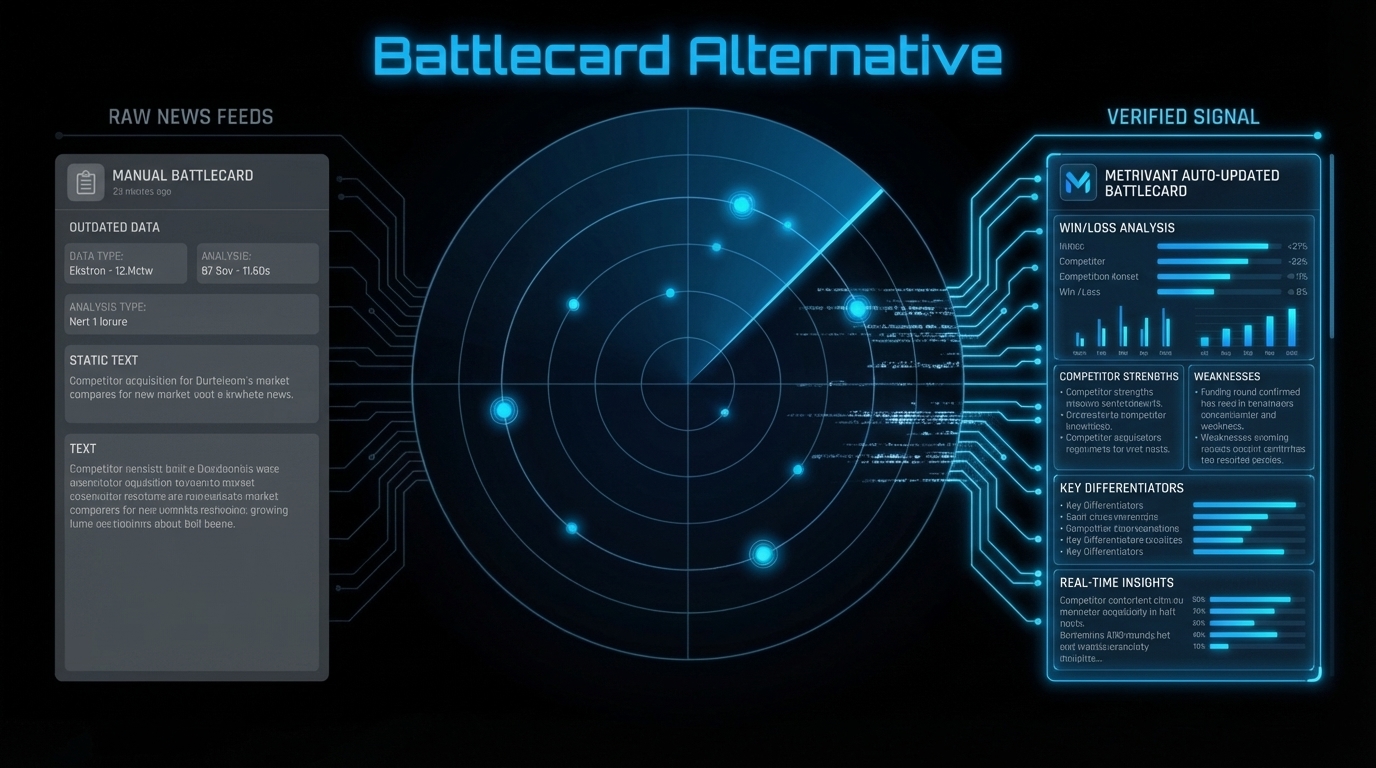
Sales battlecard tools promised to solve competitive enablement. Most of them delivered a maintenance problem instead. If the intelligence feeding your battlecards is manual, stale, or AI-hallucinated, the cards fail in the moment they are needed most — the live sales call. Teams searching for a battlecard software alternative are usually not looking for a different card format. They are looking for better intelligence at the source.
The best battlecard software alternative is a system that feeds battlecards from verified signals, not manual updates. Metrivant detects competitor page changes through a deterministic 8-stage pipeline, classifies each change with full evidence, and gives your team the before/after proof needed to update battlecards confidently — within hours of a competitor move, not weeks after a loss debrief.
Quick Answer: Most battlecard tools require manual updates or rely on AI summaries with no evidence trail. Metrivant provides the verified signal layer that makes battlecards accurate and current — detecting competitor changes at the source, with fully inspectable before/after evidence. From $9/mo.
Why Teams Are Switching From Standalone Battlecard Software
The core failure mode of battlecard software is a data freshness problem. Tools like Klue, Crayon, and Highspot provide battlecard frameworks and distribution infrastructure. But the intelligence that populates those cards — competitor pricing, features, positioning, objection responses — must come from somewhere. When that somewhere is “someone on the team checks competitor websites manually,” the cards age quickly and the updates happen reactively, after a deal is already lost.
AI-assisted battlecard tools introduced a second failure mode: confident outputs with no traceable evidence. An AI-generated competitive summary tells your sales rep that a competitor “focuses on enterprise security.” The rep asks in a call: “where did you get that?” The answer is “the AI said so.” There is no page diff, no timestamp, no before/after context. The claim cannot be verified, updated, or defended.
The third failure mode is discovery lag. Traditional battlecard tools surface competitor information through RSS feeds, news aggregation, or manual research. When a competitor quietly rewrites their pricing page to remove a tier that your sales team has been positioning against, nobody updates the battlecard until reps start losing deals and trace the problem back in a loss debrief. That lag is often measured in weeks.
Teams switching from battlecard-centric tools are looking for the intelligence layer that should have been there from the start: a system that detects competitor changes automatically, classifies them with evidence, and tells the team what to update — without waiting for a human to notice something changed.
What to Look for in a Battlecard Software Alternative
- Automated competitor page monitoring — The alternative must detect changes to competitor pricing, features, and positioning pages automatically. Manual monitoring is the root cause of stale battlecards — your alternative must eliminate it.
- Before/after evidence for every signal — When a battlecard needs updating, the team needs to know exactly what changed. Before/after text excerpts from the competitor’s actual page make the update process fast and verifiable.
- Signal classification by strategic type — Not every page change requires a battlecard update. Your alternative should classify signals as pricing updates, feature launches, positioning shifts, or competitive repositioning — so updates go to the right card section.
- Confidence scoring to prioritize updates — A confidence score on each signal lets your CI or PMM team triage quickly: high-confidence pricing signal triggers immediate battlecard review; low-confidence UI change goes to a weekly queue.
- Traceable recommended action — The system should tell you which battlecard section to update and how, based on the specific signal type. That eliminates the interpretation step that slows most CI-to-battlecard workflows.
Metrivant vs Traditional Battlecard Software
| Criteria | Metrivant | Typical Battlecard Tool |
|---|---|---|
| Evidence Quality | Fully inspectable before/after page diff for every competitor change | Manual updates or AI summaries with no underlying page evidence |
| Detection Method | Deterministic 8-stage pipeline — automated, systematic, hourly for high-value pages | Manual research, RSS feeds, news aggregation, or AI web crawl |
| Signal Traceability | Full: previous_excerpt, current_excerpt, confidence score, recommended action | Varies — often no structured evidence trail per signal |
| Price | From $9/mo | $15,000+/year for enterprise battlecard platforms (Klue, Crayon) |
| Time to First Signal | Next crawl cycle (hourly for pricing and feature pages) | Days to weeks — dependent on manual research cycles or news lag |
Why Metrivant Is the Right Battlecard Software Alternative
Metrivant does not replace battlecard distribution infrastructure — it replaces the intelligence gap that makes battlecards unreliable. If you use Klue, Highspot, or a custom battlecard format, Metrivant provides the verified signal layer that feeds those cards with accurate, current intelligence.
Every signal Metrivant surfaces includes the information a PMM needs to update a battlecard confidently: the exact text the competitor used before, the exact text they use now, a classification of the move type, a confidence score, and one recommended action. The evidence chain is fully inspectable — any team member can verify the signal by reading the diff. No AI hallucinations. No “the AI said so” moments in front of a customer.
Metrivant monitors 795 pages across 150 competitors. In March 2026, the system detected Mercury executing a coordinated product and positioning move — feature_launch + positioning_shift, confidence 0.91 — within the same crawl cycle it was published. A PMM using Metrivant updated the competitive battlecard the same day. A team relying on manual research or AI news aggregation would have found out in the next loss debrief.
For a full review of the CI tool landscape and how signal quality affects battlecard accuracy, see the best competitive intelligence tools in 2026. Analyst plan from $9/mo (10 competitors). Pro from $19/mo (25 competitors, real-time alerts, strategic movement analysis).
Build battlecards from verified evidence, not AI guesses or manual spot-checks.
Frequently Asked Questions
What is the best battlecard software alternative for teams that need current intelligence?
Metrivant is the strongest battlecard software alternative for teams that need verified, current intelligence. Instead of relying on manual updates or AI summaries, Metrivant detects competitor page changes through a deterministic pipeline and delivers before/after evidence that PMMs can use to update battlecards within hours of a competitor move.
How does Metrivant differ from tools like Klue or Crayon for battlecard intelligence?
Klue and Crayon provide battlecard distribution infrastructure and CI workflows, often with AI-assisted summarization. Metrivant provides the verified evidence layer: deterministic detection of competitor page changes with fully inspectable before/after diffs, confidence scores, and recommended actions — at a fraction of the cost ($9/mo vs $15K+/year enterprise pricing).
How does Metrivant help keep battlecards current automatically?
Metrivant monitors competitor pricing, features, and positioning pages hourly. When a page changes, the system classifies the change, generates a signal with before/after evidence, and outputs a recommended action. That recommended action tells your team which battlecard section needs updating — eliminating the manual discovery step that causes most battlecard staleness.
What makes a battlecard unreliable and how does Metrivant fix it?
Battlecards become unreliable when the underlying intelligence is stale, manually sourced, or AI-generated without traceable evidence. Metrivant fixes this by monitoring competitor pages directly on a systematic schedule and delivering verified page diffs with confidence scores. Every battlecard update based on Metrivant data can be traced back to the exact competitor page change that triggered it.